
Cargo Handling & Safety
Latest news on stowage and security material for cargo containersRecomended Topics: HANDLING EQUIPMENT CONTAINERS SUSTAINABILITY
CARGO HANDLING & SECURITY
Latest news on stowage and security material for cargo containers






Container Spreader Compatibility Guide: STS, MHC, RTG, RMG, Reach Stacker and Forklift
A container spreader cannot be selected only by checking whether it handles 20-foot or 40-foot containers. The same ISO container may be moved by a ship-to-shore crane, a mobile harbour crane, a yard gantry crane, a reach stacker or a forklift. However, each machine...

WLL vs SWL: What Is the Difference?
TermFull nameWhat it describesWLLWorking Load LimitThe maximum load assigned to the equipment under its defined design conditionsSWLSafe Working LoadThe maximum load permitted for a specific application and its actual service conditions What is the Working Load Limit?...

When should a Container Spreader be Repaired or Replaced?
Container spreaders are exposed to repeated lifting cycles, impacts, vibration, saline environments and significant mechanical forces. Over time, these conditions can cause wear in the twistlocks, hydraulic faults, sensor problems, corrosion or structural damage. The...

Manual vs mechanical vs automatic Over Height Frames
Handling overheight and out-of-gauge cargo is never a standard container operation. Flat racks, open top containers and platforms require additional clearance, safer lifting procedures and equipment that can adapt to the way each terminal actually works. This is where...

Checklist for inspecting lashing cages
In container terminals, safety often depends on equipment that performs a very specific task under demanding conditions. Lashing cages are a good example. They may look simple from the outside, but they are used in one of the most sensitive areas of port operations:...

FuelEU Maritime and OPS: what terminal operators need to prepare before 2030
The decarbonisation of maritime transport is moving from long-term ambition to day-to-day operational reality. For terminal operators, this transition will not only be measured in emissions targets or regulatory documents. It will be visible at the quay, in berth...
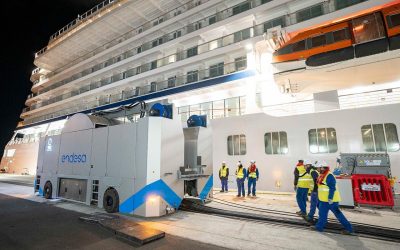
TEC CONTAINER delivers the Spain’s First Cruise Ship OPS System in Cádiz
TEC CONTAINER has achieved a major decarbonization milestone this week with the official inauguration of the country's first On-shore Power Supply (OPS) system dedicated to cruise ships at the Port of Cádiz. This project introduces critical infrastructure to...
Human Error in Container Handling and How Terminals Reduce It
Human error remains one of the most significant contributors to operational incidents in container terminals, despite the increasing sophistication of automation, digital planning tools, and safety systems. Ship-to-shore (STS) cranes, yard equipment, and lifting...

How container terminals manage peak traffic and operational stress
Peak traffic in container terminals introduces a level of operational stress that goes far beyond increased container moves. During these high-density arrival windows, planners, crane operators, and yard teams must work with tighter margins, higher uncertainty, and...

The hidden role of Small Lifting Accessories in port safety
Container terminal operations usually focus on high-visibility assets: STS cranes, yard equipment fleets, and digital planning tools. Yet, a significant portion of operational safety depends on components that are far less prominent—small lifting accessories that...