
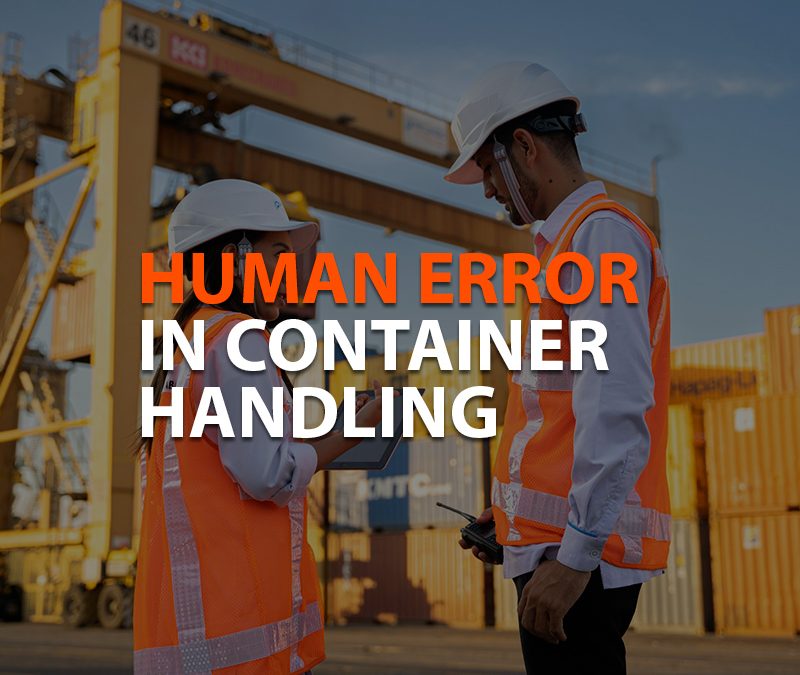
Human error remains one of the most significant contributors to operational incidents in container terminals, despite the increasing sophistication of automation, digital planning tools, and safety systems. Ship-to-shore (STS) cranes, yard equipment, and lifting accessories all function within environments where operators must make rapid and precise decisions under demanding conditions. The complexity, pace, and risk inherent in quay operations mean that even small lapses can escalate into cycle-time losses, equipment damage, and safety hazards.
Understanding how and why human errors occur—both in crane cabins and on the ground—is essential for reducing operational variability and improving terminal safety.
Why Human Error Remains a Critical Risk Factor
Container handling is a high-pressure activity. Operators must repeatedly execute precise movements while coping with external factors such as vessel motion, wind, irregular container geometries, and tight operational windows. Even when equipment is functioning properly, human limitations create risk:
- Fatigue from long shifts or peak periods reduces cognitive accuracy.
- Perceptual strain increases when dealing with low visibility, night operations, or noisy environments.
- Cognitive overload emerges when operators must process multiple alarms, container irregularities, or sudden changes in the plan.
- Decision lapses occur when operators must quickly judge whether a non-standard container requires accessories such as overheight frames.
This risk profile intensifies when external stressors—weather deterioration, vessel delays, or peak traffic—compress the operational margin even further.
Where Human Error Most Commonly Appears in the Crane Cycle
1. Container Engagement and Twistlock Confirmation
A large proportion of human errors occur during the initial engagement phase. Operators must judge:
- the container’s alignment,
- vessel motion that affects positioning,
- possible damage to the corner castings,
- whether the twistlock feedback signals are reliable.
If the operator misjudges any of these factors, it can lead to partial locking, re-tries, or unsafe lifting attempts. High-duty spreaders with clear locking feedback reduce the likelihood of misinterpretation, but human perception remains a limiting factor.
2. Identifying Non-Standard or Overheight Containers
Operators and deck crews must correctly identify when a container requires an overheight frame or other specialized lifting accessory. Errors in this step include:
- assuming a container fits ISO geometry when it does not,
- failing to notice additional structures or cargo protrusions,
- overlooking damage that affects safe lifting points.
These mistakes result in last-minute changeovers, crane stoppages, or, in severe cases, unsafe lifts. Terminals with poor pre-berth inspections or limited accessory staging see these errors more frequently.
3. Misjudging Sway, Vessel Motion, or Wind
Even experienced operators can misinterpret crane behaviour when:
- wind gusts cause sudden pendulation,
- vessel motion creates deceptive alignment cues,
- overheight frames or special spreaders alter the load’s centre of gravity.
A small over-correction can develop into increasing swing, prolonging the cycle and putting deck personnel at risk. Human misjudgment in these conditions is one of the primary causes of “repositioning loops” during hoisting and lowering.
4. Ground-Level Communication Failures
Human error also affects communication between:
- crane operators and deck crew,
- lashers and machine operators,
- signalers and vehicle drivers.
Common issues include unclear hand signals, misunderstood radio instructions, or delayed confirmation of spreader locking. These failures result in hesitations, micro-delays, and safety risks, particularly when handling damaged or non-standard containers that require additional coordination.
Why Automation Alone Does Not Eliminate Human Error
Automation reduces some failure modes but introduces new ones. Even in terminals with automated yard equipment or advanced crane assistance systems, human oversight is still required for most of the tasks mentioned above.
Operators remain responsible for interpreting system feedback, meaning cognitive overload and misjudgment continue to play a major role.
Strategies Terminals Use to Reduce Human Error
Terminals that have successfully minimized incident rates tend to apply a combined approach encompassing technology, training, and process design.
1. Error-Resistant Equipment Design
Equipment engineered to minimize ambiguity significantly lowers the likelihood of operator mistakes. Examples include:
- spreaders with clear, reliable twistlock status indicators,
- overheight frames with simplified locking mechanisms and visible confirmation points,
- lifting accessories designed to reduce the number of manual steps during attachment.
These design features reduce uncertainty during stressful or time-compressed operations.
2. Focused Training Based on Real Failure Modes
Effective training reflects real operational conditions rather than generic scenarios. The best programs address:
- engagement challenges caused by damaged containers or irregular stacks,
- safe handling of non-standard lifts with frames or adaptors,
- decision-making under wind or vessel motion,
- coordinated communication between operator and ground crew.
Simulators increasingly incorporate these variables, improving operator resilience under stress.
3. Simplified Communication Protocols
Human error often stems from unclear or overly complex communication. Terminals reduce this risk by standardizing radio terminology, the number of confirmation steps, who has decision authority during exceptions orhand signal meanings across all shifts.
Clear protocols reduce hesitation and prevent conflicting instructions.
4. Data Monitoring and Feedback Loops
Modern terminals analyse crane cycle data to identify where operators struggle most. By examining:
- re-try frequency during twistlock engagement,
- sway correction patterns,
- delays caused by accessory changeovers,
- deviation from planned productivity curves,
engineers can pinpoint human-error hotspots and adjust training, equipment configuration, or procedures accordingly.
A Safer Terminal Through Better Human-Machine Integration
Human error in container handling can never be eliminated, but its impact can be substantially reduced. Terminals that combine robust lifting equipment—such as reliable container spreaders and certified overheight frames—with disciplined procedures and targeted training achieve more stable crane cycles and fewer safety-critical incidents.
Ultimately, the goal is not to remove the human operator from the process but to design an operational environment where the human role becomes safer, clearer, and less prone to variability. When equipment, procedures, and training align, the result is a more predictable and resilient terminal operation.